
“I wasn’t just learning about the periodic table. I was learning how to think.”
For Mike McLelland, LBC class of 1976, that distinction captures what made his Lyman Briggs College education so valuable — and what has stayed with him throughout a career spanning science, business and leadership.
McLelland arrived at Michigan State University with an interest in medicine and an affinity for math and science. Lyman Briggs College offered something he found particularly appealing: the intimacy of a small college combined with the opportunities of a large research university.
He lived and learned alongside other Briggs students, with laboratories, classrooms and faculty offices close at hand. He remembers the camaraderie of the living-learning environment and the friendships he made there.
“I met some of my best friends at Lyman Briggs,” he said.
But it was the way Briggs taught him to approach problems that would have perhaps the greatest impact on his future.
Through his studies, McLelland came to see science as a practical framework for understanding and solving problems. Experimentation, analysis and iteration weren’t simply tools for scientific discovery; they were ways of learning to think. Science taught him to work through difficult problems, learn from failure and keep refining an approach. Those skills would prove useful far beyond the laboratory.
From science to business
After graduating from Lyman Briggs, McLelland spent a year working as an orderly and soon realized that medicine was not the path he wanted to pursue.
Instead, he began thinking about how he could pair the technical foundation he had developed at MSU with business expertise. In 1978 he enrolled in an accelerated MBA program at the University of Michigan.
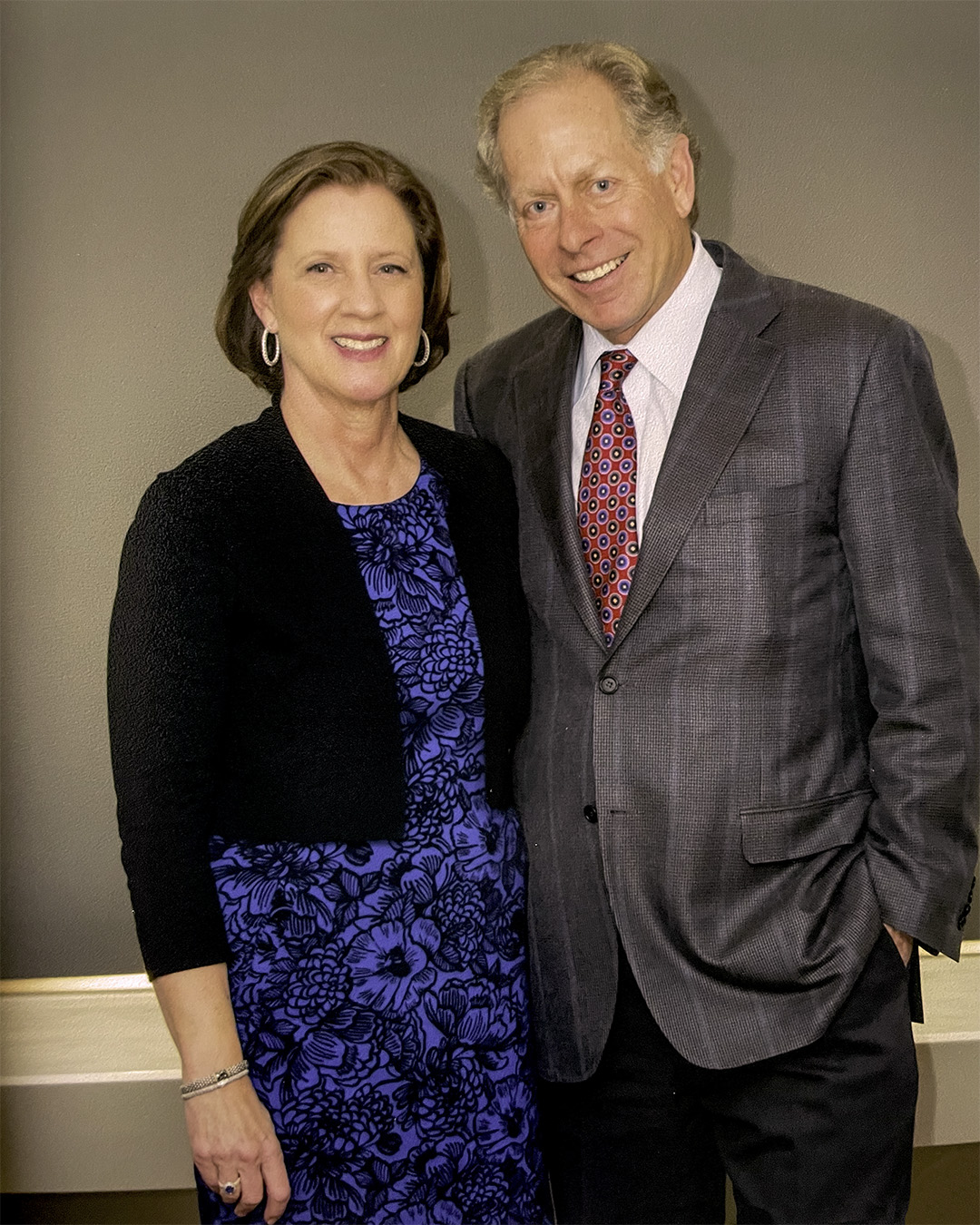
That 16-month program changed more than his career trajectory. It was where he met Nancy, who would become his wife.
Nancy, who grew up near Flint, had also entered college interested in science. At the University of Michigan, she initially considered chemistry before exploring other fields and ultimately studying genetics.
Like Mike, Nancy came to see business education as a practical complement to her scientific background.
After earning their MBAs, the couple began their careers in Detroit. They started a family and moved to Chicago in 1982, where Mike worked in finance. Three years later, they moved to Philadelphia, where Mike took on increasingly senior business and management roles, eventually becoming CEO of Berwind Corporation, a private holding company.
Throughout his career, Mike found ways to draw on both sides of his education — the analytical and technical thinking he developed as an undergraduate and the business knowledge he gained through his MBA.
Seeing education as a pathway to opportunity
As their three children became more independent, Nancy began volunteering with nonprofit organizations in the Philadelphia area. Her work focused on some of the issues that would eventually become central to the couple’s philanthropy, including health care, education and meeting essential community needs.
For Mike and Nancy, giving back became a natural extension of their own experiences.
After Mike retired, the couple established the McLelland Family Foundation. Their educational giving has supported programs ranging from inner-city schools to the University of Michigan School of Nursing and Business School, as well as Michigan State University.
For the McLellands, the reason for investing in education is straightforward: “Education a way for people to build skill sets and improve their lives.”
Investing in learning at Lyman Briggs
When Mike and Nancy recently considered making a gift to Lyman Briggs College, they spoke with Dean Kendra Spence Cheruvelil about the college’s strategic needs.
Their conversation led them to a program that reflects many of the values they have sought to support through their philanthropy: mentorship, education and opportunities for students to learn by doing.
The McLellands established the McLelland LBC Undergraduate Learning Assistant Program Expendable Fund, a new five-year fund supporting the Lyman Briggs College Undergraduate Learning Assistant (ULA) Program and its director. They also contributed to the LBC ULA endowment.
The ULA program gives undergraduate students opportunities to deepen their own learning while supporting the learning of their peers. In the process, students develop skills in communication, mentorship and teaching — experiences that can become meaningful preparation for future careers and leadership.
When Dean Cheruvelil identified support for the ULA program directorship as a strategic need and an opportunity to strengthen high-impact learning at LBC, the McLellands saw a natural fit with their philanthropic priorities.
“It’s a great program,” they said. “It grows mentorship and teaching abilities and is essential to LBC.”
Their gift is an investment not only in a program, but in the students who participate in it — and in the students they will go on to teach and mentor.
Leaving things a little better
The McLellands’ approach to philanthropy is grounded in a belief that giving does not have to take one particular form. It can mean volunteering time, supporting a student’s education or making a financial contribution, however large or small.
Their investment in Lyman Briggs carries forward a lesson Mike first learned as an undergraduate: education is about more than mastering a subject. It is about learning how to think, how to solve problems, how to learn from setbacks and how to use what you have learned to make a difference.
by Blythe White